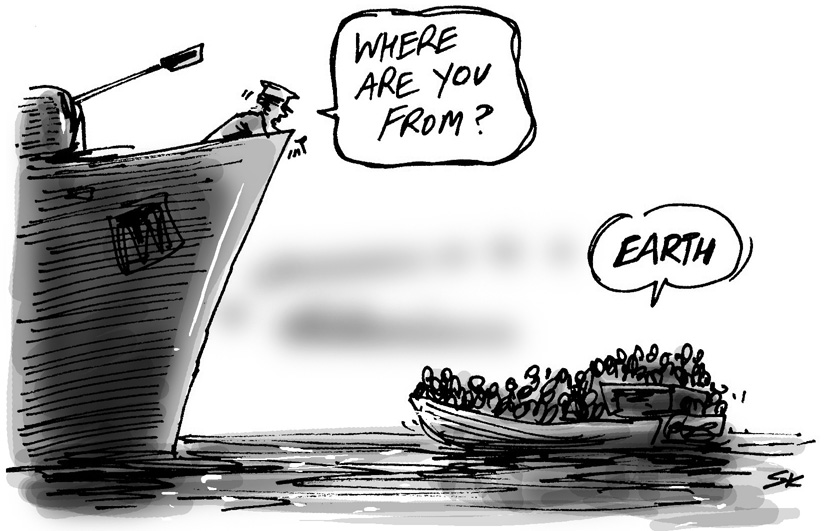
Portuguese writer Lídia Jorge quotes the ‘Where are you from?’ cartoon in her speech at the June 10 celebrations of Portugal Day, Camões and the Portuguese Communities, in Lagos:
… It is true that we only know what happened on that 8th August 1444 because the chronicler of Prince Henry the Navigator narrated it. Eanes Gomes de Zurara could not help but feel compassion and commented, movingly, on how cruel the arrival and distribution of slaves was. Fortunately, we have this page of the Chronicle of the Deeds of Guinea to be sure that there were those who did not find such degradation fair and said so. In fact, we know that there have always been those who completely repudiated the practice and theorized about it. On one of the walls of one of the museums in Lagos is written the testimony of a sixteenth-century author who denounces the injustice – “… they do not offend us, they do not owe us, nor do we have just cause to make war on them, and without just war, we cannot captivate or buy them”.
This means that Lagos, the city of Prince Henry the Navigator’s dreams, of which Sagres is the metaphor, after all these centuries, promotes awareness of what we are capable of doing to each other. It has therefore become a city against indifference. It is our contemporary struggle. In Lagos, today, the message of Simon Kneebone’s cartoon from 2014 that has been circulating the world is present, in a different way – The scene is our contemporary one, it takes place at sea. On a huge ship, equipped with defensive weapons, at the top of the tower is a crew member who sees in the distance a fragile, shallow boat, loaded with migrants. The crew member of the large vessel asks – Where do you come from? From the crowded boat someone answers – We come from the Earth . I suggest that young Portuguese people, descendants of manual diggers,sailors, seamen, grandchildren of emigrants who left barefoot in search of work, print this cartoon on their shirts when they go to sea.
Read her full speech here.




 Simon Kneebone - cartoonist and illustrator